As interest in simpler post-meal weight-management support continues in 2026, this Hinuki Lean Habit Jelly review explores the brand-stated Korean-inspired jelly-stick formula, appetite and digestive-wellness positioning, key ingredients, serving routine, pricing, subscription terms, and buyer questions to consider before ordering. This is a paid advertorial, and a commission is earned if you buy through links in this article. Product claims belong to the brand and are not independently endorsed here. Hinuki Lean Habit Jelly is a dietary supplement, not a drug, not FDA-approved, and per the brand's own disclaimer, not intended to diagnose, treat, cure, or prevent any disease.
You saw an ad. Maybe it was the "no powders, no pills" pitch, the Korean-inspired angle, or the promise that cravings get quieter. Now you are doing exactly what smart buyers do before spending money: checking the details first. Everything below comes from the brand's own live pages, its published policies, and its Terms of Service. Five minutes here and you will know more about this product than the ad ever told you.
What Is Hinuki Lean Habit Jelly and Who Is It For?
Start with the problem the brand says it is built for. It is not the person who needs a meal replacement, and it is not the person chasing a stimulant-driven metabolism spike. It is the person who finishes dinner and is standing in front of the pantry an hour later anyway. The brand calls this "food noise," that low-grade mental chatter about what to eat next, even when you are not actually hungry.
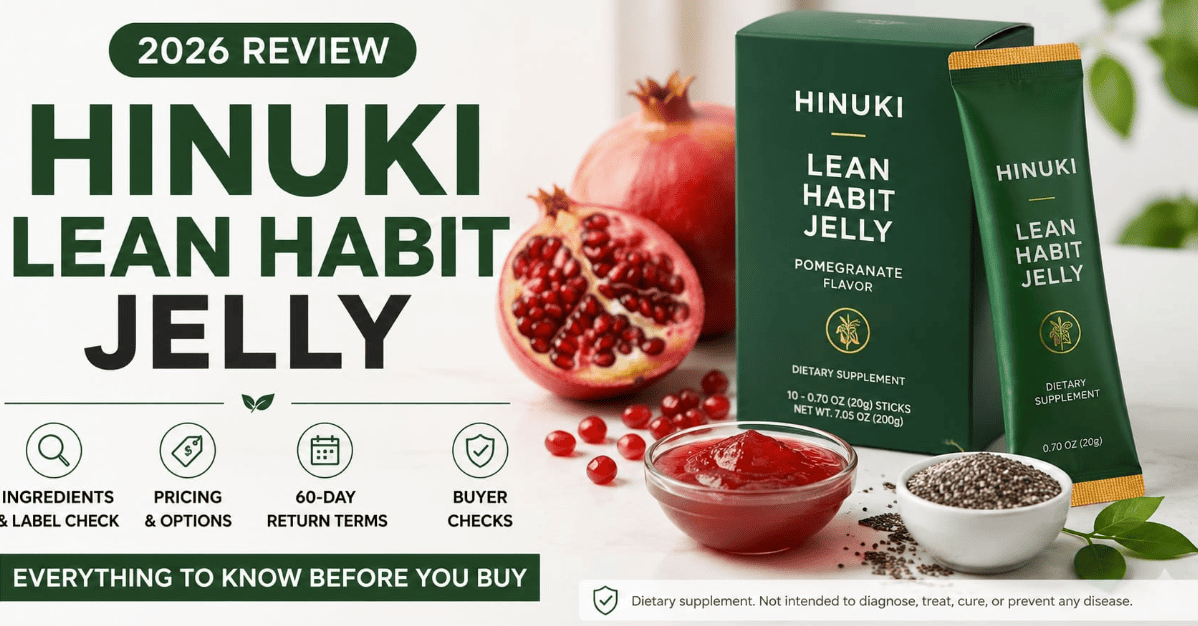
Hinuki Lean Habit Jelly is the brand's answer: a single-serve pomegranate jelly stick you eat after a main meal. According to the brand, each 20-gram sachet combines brindle berry extract, chia seeds, prebiotic fiber, concentrated red pomegranate juice, honey, and vitamin C. The format is the pitch as much as the formula. No water, no mixing, no refrigeration, nothing to blend or swallow with a glass of water. Tear, chew, done.
The brand's materials indicate the product is positioned for adults. The Terms of Service state plainly that Hinuki's goods are not intended for anyone under eighteen. The marketing skews toward women managing appetite and portion habits, particularly around afternoon and evening snacking. Per the official website, it is caffeine-free, gluten-free, and made without artificial colors, which matters if you are sensitive to stimulants or already drinking coffee through the day.
Who it fits, and who it does not
Honest two-sided framing here. This product has a specific best-fit buyer, and some clear wrong-fit buyers.
- Likely a reasonable fit if: your specific struggle is post-meal snacking and evening cravings, not mealtime overeating; you have abandoned powders or shakes because the ritual was the failure point; you want a caffeine-free option you can take in the evening; you are already working a calorie-aware diet with some regular movement.
- Likely a poor fit if: you are looking for a product with finished-product clinical evidence (none was identified); you take prescription medications and have not cleared garcinia-containing supplements with your doctor; you have a liver condition, are pregnant or breastfeeding, or are shopping for anyone under eighteen.
- Not a standalone fix: the brand itself repeatedly ties results to a calorie-controlled diet and regular activity, and its own disclaimers repeatedly disclaim weight change from the product alone.
Does Hinuki Lean Habit Jelly Work? What the Brand Claims and What Is Verifiable
Here is the honest frame, stated once and up front. Hinuki is a dietary supplement, not a drug, and it has not been FDA-approved. No finished-product clinical trial on Hinuki Lean Habit Jelly itself was identified anywhere in the materials reviewed for this article. So "does it work" cannot be answered with product-level data. Nobody can honestly answer it that way. What can be laid out is what the brand claims, what mechanism it describes, and where the ingredient-level research actually stands.
The company says the product works through the gut-brain connection. As the official site puts it, your gut and brain are constantly talking to each other, telling you when you are hungry and when you have had enough. Hinuki's brand-stated approach comes at that from three angles: brindle berry extract to help curb cravings after meals, chia seed fiber that expands after being ingested to support fullness, and prebiotic fiber that feeds beneficial gut bacteria to support smoother, more regular digestion.
On timing, the brand's own FAQ is more specific than most in this category. It states many people notice the fullness effect of the chia gel from the first sticks, while microbiome-related benefits typically build over 3 to 8 weeks of consistent daily use. That is the brand setting its own expectations bar. If you order, that is the timeline the company itself says to judge it against, and it sits neatly inside the 60-day return window covered later in this article. Individual results vary, of course; the timeline is the brand's own framing, not a guarantee.
What the research says about the ingredient categories
One distinction governs this section. Hinuki's own advertorial states it plainly, to the brand's credit: "Ingredient research reflects studies on ingredient categories generally, not on this finished product." Everything below is ingredient-level science. None of it demonstrates what this specific jelly stick, at this formula's specific amounts, does in a human body.
- Garcinia and HCA: The evidence is mixed. A 2021 review in the journal Nutrients gathered the reported data and found contradictory results. Some studies showed statistically significant weight loss; others showed no changes. The reviewers concluded that garcinia-based supplements could be effective in short-term weight loss, although the data are not conclusive.
- Soluble fiber (chia seeds): The evidence base for dietary fiber is more established than the evidence for garcinia-related weight outcomes. Soluble fiber absorbs water and forms a gel, and dietary fiber intake generally is associated in nutrition research with post-meal satiety and digestive regularity. The brand's FAQ cites 4.2g of fiber per stick, a solid chunk of the roughly 25 to 30g daily intake commonly referenced in dietary guidance.
- Prebiotic fiber (FOS): Fructooligosaccharides are among the most-studied prebiotic fibers for feeding beneficial gut bacteria. Is the amount in one 20-gram stick enough to move the needle for you? That is exactly the kind of question the label behind the product page's expandable panel answers, and the marketing pages do not.
- Pomegranate polyphenols and vitamin C: Well-documented antioxidant chemistry, and vitamin C's roles in normal energy-yielding metabolism and cellular protection are established nutrient functions. These are the claims on Hinuki's pages most readily supported as general nutrient-function statements, precisely because they are claims about nutrients, not about weight outcomes.
"The fiber and vitamin components rest on established nutrient-function evidence; the garcinia component rests on genuinely mixed evidence. Buy this as a fiber-forward post-meal habit with a studied-but-unproven appetite botanical, not as a clinically demonstrated weight-loss product."
Editorial assessment, based on published ingredient-level research
What the Product Page Says vs. What the Advertorial Page Says
This is the section you will not find in typical coverage of this product, and it matters more than any marketing claim. Hinuki runs at least two public-facing pages, a main product page and a "5 Reasons" advertorial-style presale page, and they do not fully agree with each other. None of this changes what the product is. Both pages describe the same pomegranate jelly stick. Same purpose, same company. But on the specifics, here is where they diverge, one discrepancy at a time.
The calorie and sugar numbers do not match, on the same page
The product page's hero section states "Only 10 Calories & Zero Sugar" and lists "No Added Sugar" among its badges. Yet the FAQ further down that same page states each stick contains 50 calories, 0g fat, and 1.5 to 3g sugars, alongside 4.2g of fiber. Those two statements cannot both describe the same stick. Honey is also a listed ingredient. That is consistent with the FAQ's sugar figure, and harder to square with "zero sugar." No resolution appears anywhere on the brand's accessible pages. The current nutrition label, not the marketing copy, should be used to determine which description accurately applies.
The advertorial lists ingredients the product page does not
The product page's ingredient section names six components: brindle berry, prebiotic fiber (FOS), concentrated red pomegranate juice, chia seeds, honey, and vitamin C. The advertorial page adds papaya extract, described as traditionally used for comfortable digestion. Separately, the product page's own FAQ mentions Fibersol-2, a branded resistant-dextrin fiber, which does not appear in the ingredient showcase either. A second advertorial page in the brand's funnel goes further still, describing a 22-ingredient complex and naming purple carrot as a component. Depending on which brand page you read, the formula has six, seven, eight, or twenty-two components. The current product label should settle this.
Even the product's name shifts between pages
The advertorial and checkout materials call it "Hinuki Lean Habit Jelly," while the product page's browser title reads "Hinuki Cutting Jelly." Minor, but worth knowing so you do not think you have landed on a knockoff. The footer, company registration, and contact details are identical across both pages. Both are operated by the same parent company.
Ingredients: What the Brand Pages Show and What They Do Not
Hinuki's product page does carry a Supplement Facts label. It sits behind a click-to-expand section titled "Full ingredients and nutritional information," just below the ingredient showcase. The label is published there as an image. The pages name the ingredients and describe what each is for; the FAQ discloses one specific figure. For everything else, exact amounts, excipients, allergens, that expandable label is your primary source. It is one click away.
What the brand's pages do disclose, ingredient by ingredient, as published by the brand:
- Brindle berry extract (garcinia cambogia): The brand states it supports healthy appetite control. The product page FAQ discloses approximately 750mg of HCA (hydroxycitric acid) per stick, brand-reported.
- Chia seeds: A whole-food source of soluble fiber. The company says the seeds form a gel after being ingested to support post-meal fullness. Visible whole seeds are part of the texture.
- Prebiotic fiber (FOS): Fructooligosaccharides, which the brand states nourish beneficial gut bacteria. The FAQ also references Fibersol-2 in the context of post-meal glucose response.
- Concentrated red pomegranate juice: Positioned by the brand for antioxidant support and the product's signature tart flavor.
- Honey: The brand-stated natural sweetener.
- Vitamin C: The brand cites its established roles in immune support and protecting cells from oxidative stress.
- Papaya extract: Listed on the advertorial page only, described as traditionally used to support comfortable digestion.
What this article could not verify from machine-readable pages: exact amounts for anything other than the brand-stated HCA figure, the full excipient list, allergen statements beyond "gluten free," and country-of-origin details for individual ingredients. If those specifics matter to your decision, and if you take any medication, they should, the fastest route is the product page itself. Expand "Full ingredients and nutritional information" and read the label image directly.
Is Hinuki Safe? Ingredient-Level Cautions Worth Discussing With Your Doctor
Hinuki's own FAQ raises the safety question itself: "Is Garcinia cambogia safe?" Its answer, per the brand: at the stated approximately 750mg HCA per stick, garcinia is generally well tolerated by healthy adults. Then it adds the line that matters most: "Consult your doctor if you take medication." Take that seriously. The independent literature gives it real content.
Published case reports in the medical literature have examined instances of liver injury in people using garcinia cambogia products for weight loss. The 2021 Nutrients review cited above adds the wider tally. It notes that while garcinia supplements were reported as safe in most studies reviewed, some cases of hepatotoxicity, serotonin toxicity, and mania have been reported. These are ingredient-level case reports, not findings about Hinuki specifically, and they do not establish how often such events occur. But they are exactly why blanket "it is natural, so it is safe" thinking fails buyers in this category.
Practical translation, consistent with the brand's own directions: anyone taking prescription medication or managing a medical condition, including any liver condition, should review the current ingredient label with a doctor or pharmacist before use. That conversation takes five minutes with the label in hand. It also applies if you are pregnant or breastfeeding, a group the brand's Terms of Service specifically directs to consult a healthcare professional first. Stop and consult a professional if you notice any adverse reaction. Keep the sticks away from children.
How to Use Hinuki Lean Habit Jelly Sticks
Per the brand's instructions, this could not be much simpler, and the simplicity is the whole retention pitch. Tear open one sachet after your main meal, the company says post-lunch is the sweet spot for most people, and eat the jelly straight from the pouch. No water, no mixing, no refrigeration. The brand specifically advises chewing thoroughly so the chia gel and prebiotic fiber can, in its words, get to work supporting fullness and digestion.
One usage discrepancy worth your attention. The product page's FAQ says "one stick after your main meal," while the advertorial page says "1-2 sticks daily, after a main meal." That is a doubled range, and it changes both your cost per day and how long a pack lasts. At one stick daily, a 10-stick pack covers ten days; at two, five days. The printed directions on the box govern. The brand's own Terms of Service state that instructions on the product take precedence over the website's general information. So follow the label. And do not exceed the recommended serving.
What Is Included in Each Hinuki Pack
According to the brand, each pack contains ten individually sealed pomegranate jelly sticks at 20 grams apiece, 200 grams of product per pack. The sachets are shelf-stable with no refrigeration needed, sized to fit a handbag, desk drawer, or gym bag, which is central to the "habit you will actually keep" positioning. No bonus products, digital guides, or add-on items were stated on the accessible pages at the time of writing, so treat any bundled extras you see at checkout as checkout-page offers to verify in the moment rather than standing inclusions.
Hinuki Lean Habit Jelly Pricing: One-Time Packs vs. Subscribe and Save
Pricing below was confirmed from the brand's checkout in August 2026. The checkout page itself renders its pricing dynamically, so always confirm the final total on the checkout screen before paying. Here is the one-time purchase structure as confirmed:
| Pack Size | Sticks | Total Price | Per Pack | Per Stick |
|---|---|---|---|---|
| 1 pack | 10 | $44.99 | $44.99 | ~$4.50 |
| 2 packs | 20 | $79.98 | $39.99 | ~$4.00 |
| 3 packs | 30 | $104.97 | $34.99 | ~$3.50 |
| 4 packs (Most Popular) | 40 | $119.96 | $29.99 | ~$3.00 |
One-time purchase figures confirmed at checkout in August 2026. Taxes and shipping calculated at checkout are additional.
And the Subscribe and Save structure, which bills on a recurring basis:
| Subscription | Sticks | Per Delivery | Per Pack | Per Stick |
|---|---|---|---|---|
| 1 pack monthly | 10 | $34.99 | $34.99 | ~$3.50 |
| 2 packs monthly | 20 | $59.98 | $29.99 | ~$3.00 |
| 3 packs monthly | 30 | $74.97 | $24.99 | ~$2.50 |
| 4 packs monthly | 40 | $79.96 | $19.99 | ~$2.00 |
Recurring billing at the price displayed at sign-up. Cancellation mechanics are covered in the subscription section below.
Run the per-stick math and the spread is real. The highest cost per stick is about $4.50 on a single one-time pack. The lowest cost per stick is about $2.00 on the four-pack subscription. The subscription discount is roughly a third off the equivalent one-time tier, but it is a recurring charge, and the cancellation mechanics in the next section are part of the true price.
One more thing to expect at checkout, because it is better to decide now than mid-purchase. The order page presents an upsell the brand calls the "x2 Stronger Formula," described as 2X the active ingredients for deeper gut support and stronger craving control, and available only at checkout, with a brand-stated claim that over 72% of customers add this upgrade. All of that is brand-asserted marketing. No separate label, ingredient amounts, or pricing for the upgraded version appear on the accessible pages, and the 72% figure comes with no disclosed methodology. If a double-strength version interests you, the move is to check its per-pack price and its own ingredient information at checkout before saying yes.
Does Hinuki Have a Subscription? How Auto-Renewal and Cancellation Work
Yes. The Subscribe and Save option is a genuine auto-renewal program. The brand's Terms of Service spell out how it works, and this part is worth reading before choosing that path. Per the Terms: your payment method is charged on a recurring basis, monthly or per the duration you selected, at the price displayed at sign-up. You can cancel at any time by contacting customer support through the site's contact form or by emailing the support address listed on the official site.
The timing details that matter, per the brand's stated policy:
- Cancel before dispatch: the subscription ends and that month is refunded.
- Cancel after dispatch: the cancellation applies from the following month instead.
- Processing speed: processing can run as fast as one to three business days, so do not wait until the day before a billing date to cancel.
- How you cancel: no online self-service toggle is stated in the materials reviewed, so cancellation runs through support. Keep your order confirmation email where you can find it.
- Order changes: you can modify an order only within 24 hours of placing it, by contacting support. After that window, or once the order is processed for shipment, changes and cancellations are not accepted, and your path becomes the return policy instead.
What Buyers Are Saying About Hinuki and How to Read the Reviews
The brand's pages carry substantial testimonial content: named customers describing quieter evening cravings, less post-meal bloating, smaller dinner portions, and in a couple of cases, clothes fitting looser or the scale moving alongside diet and walking routines. The advertorial page displays a 4.8 out of 5 rating. All of it is brand-reported, and none of it has been independently audited for this article. Individual results vary, and testimonial experiences are not a promise of what you will experience.
Now for the context most coverage of this product skips, drawn from the brand's own legal pages. It is the most useful consumer information in this section:
- Names and photos: Hinuki's Terms disclose, in the brand's own words, that testimonials might have fictional names and associative pictures, with real identities known to the company but not displayed without consent.
- Models: the advertorial page's own advertising disclosure goes further, stating that any photographs of persons used on the site are models.
- Moderation: the Terms disclose that reviews are moderated and the company can remove or decline to publish reviews at its discretion.
- The rating: the 4.8/5 figure appears without a disclosed review platform or total count, so the honest rendering is 4.8/5, brand-reported, with platform and review count not disclosed.
To the brand's credit, these disclosures exist and are findable. Plenty of competitors' fine print says less. But they define what the review wall is: curated, brand-controlled marketing content with anonymized or representative names and stock model photography, not an independent review feed. Weight the testimonials at exactly what the brand's own Terms say they are, and weight the 60-day return policy, which is contractual, correspondingly more.
Hinuki's 60-Day Return Terms, Decoded Step by Step
The published 60-day return window is the most concrete buyer protection in this offer. It is contractual, and conditional. So here are its actual mechanics, from the brand's live return policy page and Terms of Service, including the conditions the ads do not mention.
The window is 60 days from the date you, or someone you designate other than the carrier, physically receive the product. Delivery date, not order date. Within that window, per the published policy, you can return for a refund, exchange, or store credit, and "changed your mind" is an explicitly listed qualifying reason alongside damaged, defective, or wrong items.
Here is the process, step by step per the brand's policy:
- Contact support through the form on the official site within the 60 days, providing your full name, email, and order number. Support responds within three business days.
- Receive your RMA. If the request qualifies, support sends a Return Merchandise Authorization form, a return code, and the return address, which is a fulfillment center, not the company's office. Returns sent to the office cannot be accepted.
- Ship it back with tracking. Attach the RMA and use a tracked service. The policy warns that returns without tracking might be refused.
- Get your refund. Once the warehouse receives and inspects the return, the refund issues within 14 days to your original payment method, typically appearing in your account within another three to five business days.
Now the conditions that determine whether you actually get paid. Per the Terms, non-defective returns must arrive unused, undamaged, and in original packaging. The company reserves the right to refuse a refund on used products, or to reduce it for diminished value. You pay return shipping, and original shipping costs are not refunded. Orders bought with a discount code refund at the discounted price paid. And if a promotion included a free item, the free item has to come back too, or the whole order becomes refund-ineligible.
Read those conditions against the brand's own 3 to 8 week results timeline and you will see the tension worth planning around. Fully evaluating the product means using it, and the policy's refund conditions are strongest for unused product. The practical play if you want to trial it with maximum protection: order a multi-pack, open one pack, and keep the rest sealed. Sealed, unopened packs are the cleanest return candidates under the stated conditions. Ask support to confirm in writing how they handle partially used multi-pack returns before you open the second pack.
Where Hinuki Ships From and How Long Delivery Takes
This section exists because the brand's Terms of Service disclose something the glossy funnel pages do not emphasize. Most of Hinuki's goods are manufactured in China and may be delivered from warehouses located there. That is not a red flag by itself, an enormous share of consumer goods ships the same way, and the Terms also state the goods are designed and manufactured in accordance with applicable U.S. requirements. But it directly shapes your delivery timeline and, potentially, your costs.
The brand-stated logistics run like this:
- Processing: roughly one to three business days. The Terms say 1 to 3; the shipping policy page says 1 to 2. Take the outer bound.
- Delivery: approximately 4 to 14 business days overall, with the shipping policy's U.S. estimate at 8 to 12 business days. Realistically, plan on two to three weeks door to door.
- Carriers and tracking: EMS, DHL, or similar couriers, with a tracking number emailed after processing and trackable through your confirmation links.
- Possible import charges: the Terms note imported goods can carry duties or taxes not included in the checkout total, depending on jurisdiction. For typical small U.S. consumer orders this is uncommon, but the disclosure is there and it is the buyer's line item if it applies.
One planning note that connects to the guarantee. The 60-day return window starts at delivery, not at order, so the multi-week transit does not eat into your evaluation time. That is the buyer-favorable way this policy is written, and it is worth knowing.
How to Read Hinuki's Marketing Language
A few phrases from the brand's funnel deserve translation before you reach the checkout page, because knowing what each phrase does and does not mean is the difference between an informed purchase and an impulse one.
- "Quieter Cravings": the brand's own phrase, appearing verbatim on the product page's "Feel the Difference" section and echoed in its testimonials. It describes the experience the brand positions the product to support, reduced snacking urges after meals, through the chia-gel fullness effect and the garcinia component. It is a positioning statement, not a measured outcome.
- "70% OFF SALE" / "Flash Sale - Limited Time": the brand's own promotional framing on its advertorial page. The reference prices it discounts from are brand-stated reference points, not independently verified market prices. The number that matters is the final total on the checkout page.
- "x2 Stronger Formula" / "Over 72% of customers add this upgrade": checkout-only upsell language from the brand's order page. "2X the active ingredients" is a brand comparison to its own base formula, with no separate Supplement Facts shown on accessible pages, and the 72% adoption figure is brand-reported with no disclosed methodology.
- "Sell-out risk: High": a brand-asserted urgency phrase on the advertorial page. No independent inventory data supports or refutes it. Make your decision on the product and terms, not the counter.
- "Korean-inspired": a positioning phrase describing the jelly-stick format, which is a popular supplement and snack format in Korea.
- "Zero Sugar" / "Only 10 Calories": contradicted by the brand's own FAQ figures on the same page, 50 calories and 1.5 to 3g sugars. Treat these hero claims as unresolved until you read the printed nutrition panel.
- "Verified Customer": a brand-applied label on its testimonials. What "verified" means here is defined by the brand, not by an independent review platform, and the brand's own Terms disclose that testimonial names and pictures may not be the real ones.
How Hinuki Compares to Powders, Pills, and Gummies
Hinuki's real competition is not a specific brand, it is the formats you have probably already tried. Against powders and shakes, the jelly stick's case is friction: nothing to mix, shake, clean, or refrigerate, which matters because consistency, actually taking the thing daily, is the variable most buyers control. Against capsules, the case is experience: a tart pomegranate dessert-style bite after a meal is a ritual, a swallowed pill is a chore, and the brand leans on that difference hard. Against gummies, the case is composition. Per the brand's FAQ figures, a stick delivers 4.2g of fiber with visible whole chia, a genuinely food-like fiber load most gummies do not attempt. The same FAQ's 50-calorie, 1.5 to 3g sugar figures mean it is not calorie-free either, whatever the hero banner says.
The trade-offs run the other way too. Per-serving cost is higher than commodity fiber supplements, the format is single-flavor, and the garcinia component carries the mixed evidence and doctor-consultation caveats covered above, which a plain psyllium or chia product would not. Where this lands depends on your own history. If format friction is why past attempts died, the format difference may matter to you. If you are disciplined with capsules, the main difference left is taste and convenience.
7 Things to Verify Before You Order Hinuki
Everything above is what the brand's materials establish. Here is how to close out the open items. Each one is specific. Most take under five minutes.
- Verify the Supplement Facts panel. Open the product page, expand "Full ingredients and nutritional information," and read the label image directly, or request a photo of the current printed panel and allergen statement from support. This resolves the papaya extract and Fibersol-2 questions and gives you the actual per-stick amounts nothing on the website provides.
- Verify the real calorie and sugar figures. The same label photo settles the 10-calorie versus 50-calorie contradiction and the "zero sugar" versus "1.5 to 3g sugars" contradiction. If you are tracking macros or managing blood sugar, do not order until you have seen the panel.
- Verify the serving directions. One stick daily or up to two? The box's printed directions govern and change your cost-per-day math by half.
- Verify your checkout total and purchase type. Confirm the final price on the checkout screen matches the tier you chose, confirm any tax and shipping lines, and confirm whether the one-time or Subscribe and Save option is selected before you pay.
- Verify the return terms as they will apply to you. Ask support in writing how partially used multi-pack orders are handled under the 60-day policy, so the answer is on record before you open pack two.
- Verify your medication interactions. If you take anything prescription or manage a medical condition, take the current ingredient label to your doctor or pharmacist and clear it before ordering. The brand's own FAQ tells you to do this; the case-report literature explains why.
- Verify delivery expectations. If you need the product by a specific date, the brand-stated 8 to 12 business-day U.S. window plus processing means ordering at least three weeks ahead, and the 24-hour order-modification window means checking your shipping address the moment the confirmation email lands.
Hinuki Lean Habit Jelly Fast Facts
Quick verification snapshot as of August 2026, per brand materials reviewed:
| Attribute | Detail |
|---|---|
| Product | Hinuki Lean Habit Jelly, pomegranate jelly stick dietary supplement |
| Format | 10 individually sealed 20g sticks per pack, shelf-stable |
| Brand-listed ingredients | Brindle berry (garcinia cambogia), chia seeds, prebiotic fiber (FOS), red pomegranate juice concentrate, honey, vitamin C; papaya extract listed on advertorial page only |
| Brand-stated HCA content | Approximately 750mg per stick, brand-reported |
| Brand-stated nutrition | 50 calories, 0g fat, 1.5 to 3g sugars, 4.2g fiber per stick, per FAQ; hero banner states different figures |
| Free of (per brand) | Caffeine, stimulants, artificial colors, gluten |
| Directions (per brand) | One stick after a main meal, chewed thoroughly; advertorial references up to two daily |
| Results timeline | Fullness from first sticks; gut-related benefits over 3 to 8 weeks |
| One-time pricing | $44.99 (1 pack) to $119.96 (4 packs) |
| Subscription pricing | $34.99 (1 pack) to $79.96 (4 packs) per recurring delivery |
| Return policy | 60 days from delivery; RMA required; buyer pays return shipping |
| Refund timing | Within 14 days of warehouse receipt, plus 3 to 5 bank days |
| Ships from | China per brand Terms; U.S. delivery estimated 8 to 12 business days |
All figures reflect brand materials reviewed in August 2026. Confirm current details before ordering.
Hinuki Lean Habit Jelly FAQ
What exactly is Hinuki Lean Habit Jelly?
Hinuki Lean Habit Jelly is a single-serve dietary supplement in a Korean-style jelly stick format, sold under the Hinuki brand. Each 20-gram pomegranate-flavored sachet is positioned by the company for post-meal use to support fullness, appetite control, and digestive comfort. It is eaten straight from the pouch, with no water or mixing, and the brand markets it as a daily habit product to use alongside a calorie-controlled diet and regular activity, not as a standalone weight-loss treatment.
How many calories are in each Hinuki stick?
The brand's own pages give two different answers, which is why this article flags it. The product page's hero section states "Only 10 Calories & Zero Sugar," while the FAQ on the same page states each stick contains 50 calories, 0g fat, and 1.5 to 3g of sugars alongside 4.2g of fiber. Honey is a listed ingredient, which fits the FAQ figures. The printed nutrition panel on the box is the authoritative source. Check it before relying on either number, especially if you are tracking intake closely.
Does Hinuki contain garcinia cambogia?
Yes. The brand markets the ingredient as "brindle berry," a common name for garcinia cambogia, and its FAQ discloses approximately 750mg of HCA (hydroxycitric acid) per stick, a brand-reported figure. Independent research on garcinia for weight-related outcomes is mixed, with some studies showing modest short-term effects and others showing none, and published case reports have examined liver-related adverse events associated with garcinia-containing products. No finished-product study on Hinuki itself was identified.
Is Hinuki caffeine-free and gluten-free?
Per the official website, yes on both counts. The product badges state caffeine-free, gluten-free, and no artificial colors, and the advertorial emphasizes there are no stimulants of any kind. That makes it an option for evening use or for people avoiding stimulant-based appetite products. As with any packaged supplement, anyone with celiac disease or a serious allergy should confirm the current allergen statement on the printed label or by contacting support, since website badges are not a substitute for the label itself.
How should I take Hinuki for best results?
Per the brand's directions, eat one stick after your main meal, the company says post-lunch works best for most people, and chew thoroughly so the chia gel and fiber can do their brand-described work. The advertorial page references up to two sticks daily, so follow the printed directions on your box, which the brand's own Terms say take precedence over website information. The company recommends consistent daily use, with its stated timeline putting gut-related benefits at three to eight weeks.
How long does one pack of Hinuki last?
Each pack contains ten sticks, so at the product page's one-stick-daily direction, one pack covers ten days and the four-pack covers forty days. If your box's printed directions allow two sticks daily and you use two, those figures halve to five and twenty days. Anyone planning to evaluate the product across the brand's own 3 to 8 week results window should do this math first. A single pack does not span even the short end of that timeline at one stick per day.
How much does Hinuki cost per stick?
Working from the August 2026 checkout figures: one-time purchases run from about $4.50 per stick on a single pack at $44.99 down to about $3.00 per stick on the four-pack at $119.96. Subscribe and Save tiers run from about $3.50 per stick down to about $2.00 per stick on the four-pack at $79.96 per recurring delivery. Taxes and shipping calculated at checkout are additional, and the one-versus-two sticks daily question doubles or halves your daily cost, so the final checkout screen, read against your box's directions, is the number to trust.
Does Hinuki have a subscription, and can I cancel it?
Yes. Subscribe and Save is a recurring auto-renewal program billed at the price shown at sign-up, per the brand's Terms. You can cancel anytime by contacting support through the site's contact form or the support address on the official site, but cancellation is dispatch-dependent. If that month's shipment has not gone out, the subscription ends with that month refunded. If it has shipped, cancellation takes effect the following month. Cancel several business days before your billing date and keep written confirmation of the request.
What is Hinuki's refund policy in practice?
The brand publishes a 60-day return policy running from the delivery date, covering refund, exchange, or store credit, and "changed your mind" is an explicitly qualifying reason. The mechanics matter. Contact support first, receive an RMA form and return address, ship back tracked at your own cost, and expect the refund within 14 days of warehouse receipt plus three to five bank days. Non-defective returns must be unused and in original packaging, original shipping is not refunded, and discounted orders refund at the price actually paid.
Who pays return shipping on a Hinuki return?
You do, per the brand's Terms of Service and return policy. Return shipping costs are the customer's responsibility and are not reimbursed, and the original outbound shipping charge is not refunded either. The policy also requires a trackable shipping method, warning that returns without tracking numbers may be refused by the warehouse. Factor a few dollars of tracked postage into your worst-case math when deciding which pack size to trial, and never ship a return to the company's office address, only to the RMA-provided address.
Where does Hinuki ship from, and are there import charges?
Per the brand's Terms of Service, most Hinuki goods are manufactured in China and may ship from warehouses there, via EMS, DHL, or similar couriers with emailed tracking. The Terms disclose that depending on your jurisdiction, purchases can be subject to import duties or taxes not included at checkout. For typical small U.S. consumer orders this is uncommon in practice, but the disclosure exists and any such charge would be yours. U.S. delivery is brand-estimated at 8 to 12 business days after processing.
Is Hinuki FDA-approved?
No. The FDA does not approve dietary supplements for safety and effectiveness before they are marketed in the way it approves drugs. That is true of the entire category, not something specific to Hinuki. Under U.S. law they are regulated as a category of food, with manufacturers responsible for safety and truthful labeling. Hinuki's own pages carry the standard required disclaimer that its statements have not been evaluated by the FDA and the product is not intended to diagnose, treat, cure, or prevent any disease. Treat any supplement marketing anywhere that implies FDA approval as a red flag. The brand's pages reviewed here do not make that claim.
Are the Hinuki customer reviews real?
The brand labels its testimonials "Verified Customer" and displays a 4.8/5 rating, but its own Terms of Service disclose that displayed testimonials may use fictional names and associative pictures to protect customer privacy, and the advertorial's disclosure states photographs of persons on the site are models. Reviews are also brand-moderated. So the experiences may reflect real customer feedback held by the company, but the presentation is brand-controlled marketing rather than an independently auditable review feed. Weight it accordingly against the contractual return policy.
Is Hinuki safe to take with medications?
That is a question for your doctor or pharmacist, not a marketing page, and notably, Hinuki's own FAQ says to consult your doctor if you take medication. The garcinia and HCA component is the reason to take that seriously. Published ingredient-level case reports have examined liver-related events and interactions involving serotonergic medications. The brand's Terms also direct anyone pregnant, breastfeeding, on medication, or managing a medical condition to consult a healthcare professional before use, and the product is not intended for anyone under eighteen.
Is Hinuki Lean Habit Jelly the same as Hinuki Cutting Jelly?
Yes. One product, two names. Both come from Hinuki's own pages. The product page's browser title and hero branding use "Hinuki Cutting Jelly," while the advertorial and order pages use "Lean Habit Jelly." Nothing in the brand's materials suggests these are different formulas. The pricing, ingredients, and imagery match across both names. One caution while you search: Hinuki is not related to "Jelly Lean" gummy products marketed by other companies. That is a different product from a different maker, and reviews of it tell you nothing about this one.
What is the Hinuki "x2 Stronger Formula" upsell at checkout?
It is a checkout-only upgrade offer on Hinuki's order page, described by the brand as 2X the active ingredients for deeper gut support and stronger craving control, with a brand-stated claim that over 72% of customers add it. What the accessible pages do not show is just as important. No separate Supplement Facts, ingredient amounts, or standing price for the upgraded version appears outside the checkout flow, and the 72% figure carries no disclosed methodology. If a double-strength version appeals to you, review its per-pack price and ingredient information at checkout before accepting, and if you decline, your base order goes through unchanged.
What is the official Hinuki website?
The official product page reviewed for this article sits at hinuki.com/hinuki/product. That is where the ingredient showcase, the expandable "Full ingredients and nutritional information" label, the customer testimonials, and the FAQ live. A separate brand-published advertorial page exists at hinuki.com/fnl/adv/hinuki-5-reasons, which Hinuki itself labels as an advertorial. Treat it as supporting marketing material rather than a second official spec source. Whichever page you arrive through, confirm specs, pricing, and policies against the current brand pages and the printed label, then order.
Buyer Verification Checklist
If you decide to order, this sequence protects you at each step:
- Read the Supplement Facts label under the product page's "Full ingredients and nutritional information" panel, or request a photo of the printed label from support, before ordering.
- Decide in advance on the checkout-only "x2 Stronger Formula" upsell, and if you want it, ask for its ingredient amounts and per-pack price before accepting.
- Clear the ingredient list with your doctor or pharmacist if you take any medication or have a liver condition.
- Decide your pack size using the printed serving directions. One versus two sticks daily changes everything.
- At checkout, confirm whether one-time or Subscribe and Save is selected, and screenshot the final total.
- Check your shipping address in the confirmation email immediately. Order changes are only accepted within 24 hours.
- Note your delivery date when the package arrives. Your 60-day return window starts that day.
- Judge results against the brand's own 3 to 8 week timeline, keeping unopened packs sealed.
- If returning, contact support for the RMA first, ship tracked to the RMA address only, and keep the tracking number until the refund posts.
The Bottom Line on Hinuki Lean Habit Jelly
Strip away the funnel. Here is what is actually on the table. Hinuki Lean Habit Jelly is a well-packaged idea. It combines a fiber-forward jelly-stick format with ingredients that carry varying levels of ingredient-specific research behind them, wrapped in a format pleasant enough that you will actually take it daily. In a category littered with abandoned tubs of powder, that is a distinctive convenience-focused format. The company behind it publishes a consistent corporate identity, a published 60-day return window that starts at delivery, subject to eligibility and return conditions, and unusually candidly, legal pages that disclose its own testimonials may use fictional names and model photos.
What it does not offer is finished-product evidence or internally consistent nutrition numbers. The 10-versus-50-calorie contradiction sits unresolved on the brand's own page, and the ingredient list varies between its two funnels. None of those gaps is disqualifying, and every one of them is closeable with a single email to support before you order.
So what are you actually buying here? That is the whole decision. If it is a caffeine-free post-meal fiber habit with a real refund window and a price you have done the per-stick math on, the published terms support that purchase. A smaller one-time order, evaluated against the brand's own 3 to 8 week timeline, avoids recurring billing while you decide whether the format suits your routine. If what you want is demonstrated weight-loss efficacy, this product's evidence base cannot deliver that, and to its credit, the fine print never quite claims it can. Order with your eyes open, verify the two open items first, and let the 60-day window do its job.