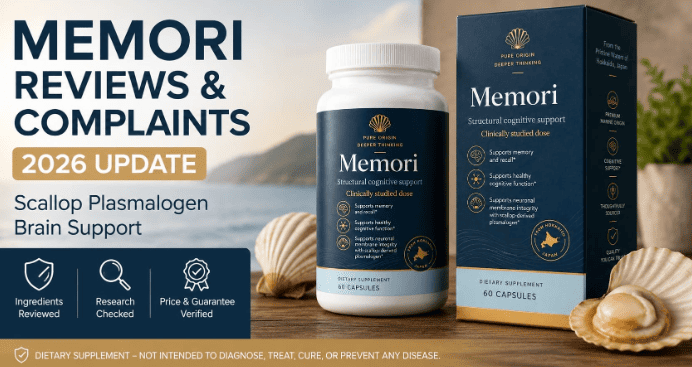
Memori's "clinically studied dose" claim is under review here: does the brand's own cited research actually back it up? Memori Mind is a single-ingredient capsule delivering 1000mcg of scallop-derived plasmalogen daily, priced from $37.91, backed by a 60-day guarantee. This Memori reviews and complaints breakdown checks the brand's own cited clinical trial against what it actually found, takes a closer look at an unverified physician quote, and covers pricing, refund terms, and a few surprising gaps before you order.
You saw an ad for Memori. Maybe it was a Facebook post about a "hidden structural system" in your brain, maybe an Instagram reel about scallops and memory, maybe a friend mentioned the name after a conversation about "brain fog." Something caught your attention, and now you are doing exactly what smart buyers do before spending money: checking the details first. That is a good move, because the brand's own cited clinical trial tells a more complicated story than the ad does. Here is what it actually says.
What Is Memori and Who Is It For?
Memori Mind is a single-ingredient dietary supplement built around scallop-derived ethanolamine plasmalogen, positioned by the brand as "structural cognitive support" for adults noticing self-reported memory and word-recall changes. According to the brand, Memori is intended for adults 45 and over experiencing self-reported cognitive changes such as word-finding difficulty, slower recall, brain fog, and mental fatigue, but whose doctor says their tests are fine. The brand states plainly that Memori is not for people with a clinical diagnosis of Alzheimer's disease or dementia, and is not intended to treat, cure, or prevent any disease.
If any of this sounds familiar, the brand's own marketing describes it in specific, recognizable moments: losing a name you have known for twenty years mid-conversation and laughing it off, struggling to follow a phone call with your kids, rereading the same paragraph without it sticking, walking into a room and blanking on why. Per the brand, Memori is built for exactly that particular, frustrating in-between: not memory loss serious enough to worry a doctor, but real enough that you have started noticing it yourself, and started wondering what to do about it.
That distinction matters for how you read the rest of this article. The brand's own audience definition separates "worried but clinically normal" adults from anyone already diagnosed, a meaningful line because the clinical research behind this ingredient was actually conducted in a diagnosed-patient population, not in healthy adults with subjective complaints.
Buyer takeaway: Memori is marketed to the "I'm fine on paper but something feels off" audience specifically, not to people managing a diagnosed cognitive condition, and not (per the brand's own FAQ) as a replacement for medical evaluation of memory changes.
Memori Ingredients: What Does It Actually Do?
Per the brand's materials, Memori delivers 500mcg of scallop-derived ethanolamine plasmalogen twice daily, morning and evening with food, for a total of 1000mcg. The brand's FAQ specifies the plasmalogen is sourced from Hokkaido scallops, which it describes as one of the richest natural sources of ethanolamine plasmalogen, the form most concentrated in neuronal cell membranes. Plasmalogens are a class of structural phospholipids that make up part of the outer membrane of neurons. The brand's site describes them as "the actual building material your brain cells use to connect, communicate, and fire cleanly," rather than a herb, vitamin, or stimulant.
The Three Claimed Mechanisms
The brand attributes three claimed mechanisms to the ingredient:
- Structural. Supports membrane integrity of neuronal cells.
- Antioxidant. Scavenges free radicals said to damage synaptic structures.
- Anti-inflammatory. Reduces neuroinflammation the brand says depletes plasmalogen further.
These are presented as the brand's explanation of how the ingredient is thought to work, not as independently confirmed outcomes of taking this specific product.
Buyer takeaway: The single-ingredient formula makes the disclosed ingredient and dose easier to identify than a multi-ingredient proprietary blend would be. There is no blend to decode, just one ingredient and one dose to evaluate, which is exactly why the research section below is worth reading carefully.
What the Research Says About Scallop-Derived Plasmalogen
Per the brand's official website, Memori's dose is described as "the clinically studied dose (Fujino 2017 RCT, 328 participants, 24 weeks)." That citation checks out as a real, publicly indexed study: Fujino et al., "Efficacy and Blood Plasmalogen Changes by Oral Administration of Plasmalogen in Patients with Mild Alzheimer's Disease and Mild Cognitive Impairment," published in EBioMedicine in 2017 (volume 17, pages 199 to 205). On the headline numbers, the brand's citation matches the published study:
- Design. Multicenter, randomized, double-blind, placebo-controlled trial.
- Participants. 328 enrolled.
- Duration. 24 weeks.
- Dose. 1mg (1000mcg) per day of scallop-derived purified plasmalogen.
- Population. Diagnosed mild Alzheimer's disease or mild cognitive impairment (MCI), ages 60 to 85.
What the Fujino 2017 Trial Actually Found
This is the section worth reading before you order. The Fujino 2017 trial enrolled 328 patients aged 60 to 85 who had already been diagnosed with mild Alzheimer's disease or mild cognitive impairment (MCI), not healthy adults with subjective "brain fog." The published trial reports twice-daily administration of the 1mg daily dose, and found no statistically significant between-group difference in the primary or secondary outcomes. Post-hoc subgroup analyses reported some possible benefit in a mild-AD subgroup, particularly women under 77. Findings researchers and independent reviewers describe as hypothesis-generating rather than confirmatory, since subgroup analyses run after a trial's primary result misses significance carry a higher risk of chance findings.
Put plainly: the brand's marketing language, with phrases like "the clinically studied dose" and "independent research now confirms scallop-derived plasmalogen is exactly what the aging brain needs," implies a level of proven efficacy that the cited trial's own primary result does not establish. The trial is real, and the dose match is accurate. In the intention-to-treat analysis, the trial's authors reported no statistically significant difference between the plasmalogen and placebo groups in the primary or secondary outcomes, and the trial reported no severe adverse events and no statistically significant difference in reported adverse events between the two groups over the 24-week study. But "clinically studied" and "clinically proven to work" are not the same claim, and the population studied (diagnosed AD and MCI patients aged 60 to 85) is not the same population Memori is marketed to (self-reported "brain fog" in adults 45 and over without a diagnosis).
Buyer takeaway: The 1000mcg daily amount matches the dose used in the cited 2017 trial. That trial's primary cognitive-outcome measure did not reach statistical significance. Any purchase decision should treat that gap honestly rather than assume "clinically studied" means "clinically proven effective for this use case."
Separately, the broader plasmalogen research base includes additional Fujino-led trials in different populations (moderate-to-severe Alzheimer's patients in an open-label design, and a study on general memory complaints), plus unrelated research on plasmalogens and mood or concentration in young athletes. None of these additional studies were cited by the brand on the pages reviewed for this article, and none were tested on the finished Memori product itself. They represent ingredient-level research on plasmalogen generally, not product-specific data.
The Doctor Behind the Quote
The brand's sales page features a quote attributed to "Kenjiro Tanaka, MD," dated March 18, 2026, describing plasmalogen research as "one of the most compelling areas in brain ageing science." This publication was unable to verify the quoted individual's credentials through the public sources checked for this review, including a general web search for the name alongside relevant medical and research terms. Because the brand page does not provide a licensing jurisdiction, institutional affiliation, or publication profile for this person, the quotation should be treated as brand-published commentary unless the brand provides additional documentation.
"One of the most compelling areas in brain ageing science."
Kenjiro Tanaka, MD, as published by the brand, March 18 2026
To be clear about what this does and does not mean: this is not an accusation that the quote is fraudulent, and this article does not assert that "Kenjiro Tanaka, MD" does not exist. It states, plainly and once, that the credential as presented could not be independently verified from publicly available sources at the time of this review. If you want to evaluate the quote's weight for yourself, that is the gap to be aware of before you do.
Buyer takeaway: Treat the "Kenjiro Tanaka, MD" quote as brand-published commentary, not as independently verified expert endorsement, until the brand provides a credential source that can be checked.
How to Use Memori
Per the brand's dosing instructions: one 500mcg capsule in the morning with breakfast, and one 500mcg capsule in the evening with dinner, for a total of 1000mcg daily. The published Fujino 2017 trial reports twice-daily administration of its test substance, so Memori's morning-and-evening schedule matches the trial's dosing frequency, though as covered above, the finished Memori product itself was not the product tested in that trial.
The brand advises storing capsules in a cool, dry place away from direct sunlight and heat, since plasmalogen is described as sensitive to oxidation, and keeping the container sealed between uses.
Buyer takeaway: The brand's twice-daily directions are consistent with the administration frequency reported for the cited trial, although the finished Memori product itself was not tested.
Memori Pricing
Per the brand's product-page listing at the time of this review, all three tiers include free US shipping. Because the brand's cart and checkout screens render pricing dynamically in the browser, these figures reflect the product-page listing rather than a live checkout capture. Confirm the final total at checkout, since pricing and promotions can change.
| Bundle | Listed Price | Per Bottle | Shipping |
|---|---|---|---|
| 1 Bottle | $37.91 | $37.91 | Free US |
| 3 Bottles | $69.46 | $23.15 | Free US |
| 5 Bottles | $96.09 | $19.22 | Free US |
Prices reflect the brand's product-page listing at the time of this review. Reference prices shown on the brand's site are brand-stated comparison figures, not independently verified prior selling prices.
One detail worth flagging before you check out: the product page also displays "Refills ship every 4, 8 or 12 weeks" with a "Stop or cancel anytime" note, indicating an auto-refill or subscription option exists alongside one-time purchase. This subscription detail did not appear in the brand's originally provided product materials and surfaced only on the live product page. It is addressed in the verification section below.
Buyer takeaway: Read the checkout screen carefully. If a refill or subscription option is selected by default or by bundle choice, confirm the cancellation mechanism before completing your order, since no dedicated subscription policy page was found on the brand's site to document it in writing.
What Buyers Are Saying
The brand displays an aggregate rating of 4.8 out of 5, described on-page as "Excellent" and attributed to Trustpilot, based on 4,752 reviews, alongside individually featured customer accounts marked "Verified Customer." This rating and review count are brand-reported figures. The article did not independently confirm the displayed Trustpilot rating from a directly matched public profile during this review, so the 4.8/5 score and 4,752-review count should remain attributed to the brand rather than treated as independently audited.
The featured written testimonials describe subjective experiences with word-finding and conversational recall. Per the brand's own presentation, these are individual accounts, and results are described elsewhere on the page as varying by person. The article did not independently authenticate the displayed reviews, and no aggregate outcome data beyond the star rating was provided to support how representative these accounts are of the broader customer base.
Buyer takeaway: Brand-reported testimonials, however specific and detailed, are not a substitute for the clinical outcome data discussed above. Weigh both together, not the testimonials alone.
The 60-Day Money-Back Guarantee
Per the brand's stated shipping and returns terms: Memori is backed by a 60-day money-back guarantee, described as valid if a customer is "not satisfied for any reason," with the customer contacting the brand within 60 days of their first purchase for a full refund. Notably, the brand's own language states the customer "keeps the product": the brand states that no product return is required under its current guarantee, which is presented here exactly as stated by the brand at the time of this review.
Here is what is not specified anywhere in the materials reviewed:
- Which entity processes the refund.
- What method is used to initiate it (email, phone, an online form).
- How long a refund takes to post once requested.
No separate refund-policy page beyond the summary on the main product page was located.
Buyer takeaway: The brand states that its "no return required" guarantee term applies regardless of reason. The lack of a dedicated refund-policy page spelling out the request mechanism and processing timeline is a real gap, worth confirming in writing (a screenshot of the confirmation email, for example) at the time of purchase.
Things to Verify Before You Order Memori
Here is how to close out the open items in this review before you buy. These are not reasons to be scared off, just specific gaps worth confirming directly with the brand.
- Legal entity name. No Terms of Service page was found anywhere on the brand's site, and no incorporated company name (no "Inc.," "LLC," or similar) appears anywhere in the materials reviewed. Ask the brand directly for the legal entity name behind Memori before ordering if that matters to you.
- Contact mechanism. The site's dedicated Contact page loaded without any visible contact form, phone number, or additional email when reviewed live for this article. No phone number was found on any page reviewed.
- Subscription or refill cancellation mechanics. The product page states refills ship every 4, 8, or 12 weeks and can be stopped or canceled "anytime," but no dedicated subscription policy, cancellation notice window, or written cancellation procedure was found. Confirm in writing, at the time of purchase, exactly how and when to cancel if you select a recurring option.
- Third-party rating source. The brand states its 4.8/5 rating (4,752 reviews) is from Trustpilot, but an independent, directly accessible Trustpilot listing for the brand was not located during this review. Search Trustpilot directly for the brand name before relying on the displayed rating.
- Certifications. The brand states the product is "third-party tested" and "Assembled in the USA," but does not name the testing lab, certifying body, or facility registration on the pages reviewed. If GMP, NSF, or USP certification matters to your purchase decision, ask the brand which body performed the testing and request documentation.
Buyer takeaway: Readers can weigh these five unresolved items according to their own purchasing criteria. Together, they provide a due-diligence checklist for this purchase.
Memori Side Effects and Safety Information
The brand's safety information does not list specific adverse effects tied to the finished Memori product itself, beyond a shellfish-allergen warning for anyone with a diagnosed allergy. Separately, the cited Fujino 2017 trial reported no severe adverse events and no statistically significant difference in reported adverse effects between the plasmalogen and placebo groups over the 24-week study period. The brand advises anyone taking prescription medication, particularly for blood pressure, cholesterol, or neurological conditions, to consult a doctor before starting, and advises pregnant or nursing individuals to do the same.
- Allergen. Contains shellfish (scallop).
- Reported trial safety data. No severe adverse events, no significant difference vs placebo in the Fujino 2017 trial.
- Brand advisory. Consult a doctor if pregnant, nursing, or taking prescription medication.
- FDA status. Not evaluated by the FDA; not intended to diagnose, treat, cure, or prevent any disease.
Buyer takeaway: The shellfish allergen warning is the one safety item to take seriously and act on before ordering. Everything else here is standard supplement-label caution rather than a product-specific red flag.
Lander Phrase Glossary: What Memori's Marketing Language Actually Means
Several phrases on the brand's sales page are brand-originated marketing language. This section explains each phrase's source and what it does and does not establish.
| Phrase | Source | What It Means | What It Does Not Mean |
|---|---|---|---|
| "Clinically studied dose" | Brand product page | The 1000mcg daily amount matches the dose used in the real, published Fujino 2017 trial. | That trial's primary cognitive-outcome measure reached statistical significance. |
| "Independent research now confirms..." | Brand product page | The brand is characterizing the plasmalogen research base as supportive of its claimed benefits. | An independent third party has confirmed the finished Memori product produces these outcomes. |
| "Japan-sourced science" | Brand "Why Choose Memori" section | The ingredient and underlying research trace to Japan (scallop sourcing and the Fujino research group are both Japan-based). | The finished product is manufactured in Japan; the brand separately states it is "Assembled in the USA." |
| "Structural vs symptomatic" | Brand comparison chart | The brand is positioning its ingredient as targeting structural lipids directly. | A peer-reviewed head-to-head clinical comparison against competing ingredients. |
Source: brand product page and sales materials reviewed in August 2026. Phrases are reproduced here for analysis, not as endorsements.
Quick Answers: Your Most Common Memori Questions
Does Memori Actually Work?
Memori's dose matches a real 2017 clinical trial on scallop-derived plasmalogen, but that trial's primary cognitive-outcome measure did not reach statistical significance in diagnosed Alzheimer's and MCI patients. The ingredient and dose are accurately cited. Whether it produces noticeable benefit for the self-reported "brain fog" audience Memori targets remains unconfirmed by that research.
What Does a Bottle of Memori Cost?
A single 60-capsule bottle of Memori costs $37.91, per the brand's product-page listing. Bundle pricing brings the per-bottle cost down further: $69.46 for three bottles, or $96.09 for five bottles, both with free shipping included per the brand's stated terms. Confirm the exact total at checkout, since pricing and promotions can change.
Is Memori's Money-Back Guarantee Legitimate?
Memori offers a 60-day money-back guarantee from the date of first purchase, and the brand states customers keep the product with no return required. The specific refund mechanism, processing timeline, and issuing entity are not detailed on a separate policy page, so confirm the process in writing at checkout.
Who Should Avoid Memori?
The brand does not position Memori for people with a diagnosed Alzheimer's or dementia diagnosis. Anyone with a shellfish allergy, especially a history of severe or anaphylactic reactions, should get individualized medical advice before using it. It is also not the right fit if you expect a statistically confirmed cognitive-improvement outcome rather than an inconclusive research signal.
Is the "Clinically Studied Dose" Claim Accurate?
The 1000mcg daily dose does match the dose used in a real published trial: Fujino et al., 2017, EBioMedicine. However, that trial's primary cognitive outcome measure did not reach statistical significance, and the study population was diagnosed Alzheimer's and MCI patients aged 60 to 85, not the broader self-reported "brain fog" audience the product targets. The dose citation is real. The implied efficacy claim outruns what that trial actually demonstrated.
Does Memori Have Any Side Effects?
The brand's safety information does not list specific adverse effects associated with the finished product, beyond a shellfish-allergen warning that applies to anyone with a diagnosed allergy. Separately, the cited Fujino 2017 trial reported no statistically significant difference in adverse effects between the plasmalogen and placebo groups over the 24-week study period. Anyone taking prescription medication, particularly for blood pressure, cholesterol, or neurological conditions, is advised by the brand to consult a doctor before starting.
Can I Take Memori if I Have a Shellfish Allergy?
The brand advises that anyone with a diagnosed shellfish allergy must consult a physician before use, since Memori is extracted from scallop tissue. The brand states its extraction process removes most allergenic proteins but cannot guarantee the complete absence of shellfish allergens for people with severe or anaphylactic reactions. This is a genuine safety consideration to take seriously rather than a boilerplate formality. If you have had a severe or anaphylactic reaction to shellfish in the past, treat this as a firm stop-and-ask-your-doctor situation.
Buyer Verification Checklist
Before you order, work through these eight items. Each one closes a specific gap identified in this review.
- Confirm the legal entity name operating the brand's official site directly with the brand before ordering.
- Request written confirmation of the refund process and expected processing timeline before you need it.
- If selecting a bundle with a recurring refill option, get the cancellation method and notice period in writing.
- Search Trustpilot directly to independently check the brand's displayed rating and review count.
- If a shellfish allergy applies to you, consult your physician before ordering, regardless of the brand's stated extraction process.
- Ask the brand which laboratory or certifying body performed the "third-party tested" claim, if certification matters to your decision.
- Screenshot your order confirmation and any guarantee-related emails at the time of purchase.
- If you are taking prescription medication for blood pressure, cholesterol, or a neurological condition, confirm with your doctor before starting.
The Bottom Line
Memori has a single disclosed active ingredient and one principal trial cited by the brand: one ingredient, one dose, one cited trial. That makes the gaps easier to name specifically rather than hide behind a ten-ingredient proprietary blend. The dose is real and accurately matched to a genuine 2017 clinical trial. The trial's primary cognitive-outcome measure did not reach statistical significance in its studied population, and that population (diagnosed Alzheimer's and MCI patients aged 60 to 85) differs from the self-reported "brain fog" audience the product targets. The brand currently states that its 60-day guarantee does not require the product to be returned. The absence of a disclosed legal entity name, a working contact page, and a documented subscription-cancellation process are real, specific gaps rather than vague concerns.
The information reviewed here is insufficient to determine fraud or illegitimacy. Instead, this article identifies specific claims and business details that remain unverified. The marketing language (with phrases like "clinically studied" and "independent research now confirms") is doing more persuasive work than the cited research, taken on its own terms, fully supports. None of that changes what is actually on offer: a single, clearly disclosed ingredient at a real research-matched dose, a guarantee the brand says does not require the product back, and free shipping on every tier. If you decide to order, do it with the verification items above in hand, and keep written confirmation of the guarantee terms at the point of purchase.
Buyer takeaway: Judge Memori on what is confirmed: its disclosed ingredient, a dose that matches the cited trial, and the brand's published guarantee terms, rather than on the brand's framing of what that research proves.