If Protaflo has caught your eye, the most useful thing you can do before ordering is compare the sales page with the Supplement Facts panel. That is where most reviews stop, and it is exactly where the details get interesting. What follows is a neutral breakdown of what the label actually lists, what the brand says, and the spots where the two do not quite match.
This is a paid advertorial, and a commission is earned if you buy through the links on this page. Protaflo is a dietary supplement, not a drug. It is not FDA-approved and is not intended to diagnose, treat, cure, or prevent any disease. All efficacy claims below are attributed to the brand unless otherwise noted.
Protaflo at a Glance
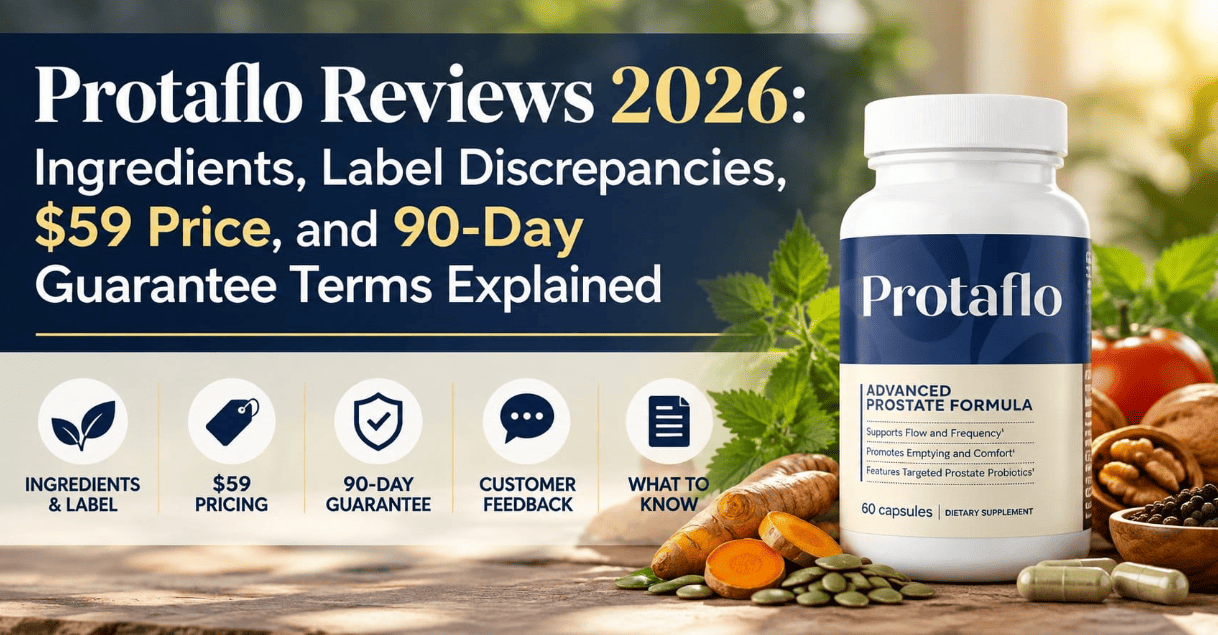
Protaflo (shown as "Protaflo Advanced Prostate Support" in the brand's pricing text) is a capsule supplement sold through the brand's offer page. The brand frames it around a three-step story it calls cleanse, restore, and rebuild, with a five-strain probiotic blend as the centerpiece.
Format and positioning
Two capsules per serving, 30 servings per bottle, 60 capsules total. The brand positions the product for men dealing with nighttime bathroom trips, a weaker urine stream, or general prostate discomfort. That positioning is marketing, not a diagnosis. Urinary symptoms in men can come from several different causes, and only a clinician can identify which one applies to you.
Main label components
The panel lists a five-strain probiotic blend, plant extracts (turmeric, a beta-sitosterol complex, nettle, black walnut hull, pumpkin seed), lycopene, and several vitamins and minerals. The brand's sales copy adds framing language about a "prostate microbiome" and "hidden invaders" that does not appear on the label itself.
"A supplement page cannot tell you which cause is yours. A clinician can."
Buyer takeaway, label versus marketing
Protaflo Ingredients: What the Label Panel Shows
Per-serving breakdown
The panel below comes from the brand's supplied page text, not from a physical bottle. Serving size is 2 capsules, with 30 servings per container.
| Ingredient | Amount per serving | Daily Value note |
|---|---|---|
| Vitamin D3 (cholecalciferol) | 50 mcg | 250% DV |
| Zinc (zinc picolinate) | 15 mcg | 136% DV as printed |
| Selenium (L-selenomethionine) | 200 mcg | 364% DV |
| Pumpkin seed | 320 mg | No DV established |
| Turmeric root extract 95% curcuminoids | 200 mg | No DV established |
| Beta-sitosterol complex 40% | 130 mg | No DV established |
| Black walnut hull powder | 100 mg | No DV established |
| Nettle leaf | 100 mg | No DV established |
| 5-strain probiotic blend | 50 mg (6 billion CFU) | No DV established |
| Lycopene | 15 mg | No DV established |
| Black pepper extract (BioPerine) | 5 mg | No DV established |
| Vitamin K2 (MK-7) | 100 mcg | No DV established |
Other ingredients: hypromellose, magnesium stearate, microcrystalline cellulose, MCT oil powder, silicon dioxide. Allergen statement: contains tree nuts (walnut).
The two lines worth a second look
Two ingredient lines carry numbers that deserve scrutiny. The zinc line prints 15 mcg beside a 136% Daily Value, and that percentage does not square with a microgram-scale amount. It looks like a printing or transcription issue. The nettle line lists leaf, while the sales copy describes stinging nettle root. Root and leaf are different plant parts, and the label is the more reliable document.
Sales Page vs Label: The Details That Differ
The sales copy and the supplement panel agree on what Protaflo is, a prostate-focused capsule. They differ on a few specifics. Where they disagree, this review defaults to the label and does not guess why.
- Nettle, root or leaf. The sales copy says "Stinging Nettle Root," while the panel lists nettle leaf at 100 mg.
- Zinc, the unit. The panel prints 15 mcg beside a 136% Daily Value, which does not match a microgram-scale amount.
- Pumpkin seed, seed or oil. The sales copy refers to pumpkin seed oil in its study discussion, while the panel lists pumpkin seed without specifying an oil.
- Concentrated clinical dose language. The panel confirms the amounts, but it does not say how those amounts compare to any study dose.
- Probiotic blend, one number for five strains. The panel prints a single 50 mg blend weight and a single 6 billion CFU figure, with no per-strain amounts.
None of these is a reason to walk away on its own. Each is an open item you can close with one written question to the brand before you order.
What the Research Says About Protaflo's Ingredients
Beta-sitosterol: real but dated research
A Cochrane systematic review of beta-sitosterols for benign prostatic hyperplasia (BPH) found that, in four short trials, beta-sitosterol treatments improved urinary symptom scores and flow measures in men with mild to moderate BPH. The same review reported no significant reduction in prostate size compared with placebo. The trials were short, the preparations differed, and standardized doses have not been clearly established. The review dates to 1999 and 2000, and Cochrane's complementary medicine group labels its prostate-enlargement summaries as outdated and of historical interest.
Everything else on the label
For nettle, curcumin, lycopene, pumpkin seed, black walnut, and the probiotic strains, the brand's page cites journals and studies by name. Those citations were not independently pulled for this review, so they are treated as brand-stated. Ingredient-level research does not automatically carry over to a twelve-ingredient capsule, and no finished-product trial of the Protaflo formula was confirmed in the materials reviewed.
Why the distinction matters
Studies on an ingredient tell you what that ingredient did, at that dose and in that form, in that group of people. They do not tell you what a different blend of twelve ingredients does. When the brand says the five probiotic strains are "clinically shown" to do something, that is a statement about strains, not about the finished capsule.
Protaflo Price and Package Options
The brand's materials displayed three package options in October 2026. The "reduced from" figures are reference points set by the brand, not independent price benchmarks.
| Package | Per bottle | Total | Shipping |
|---|---|---|---|
| 1 bottle, Starter Pack | $59 | $59 | $4.95 |
| 3 bottles, Doctor's Choice | $49 | $147 | Free |
| 6 bottles, Best Value | $39 | $234 | Free |
Prices displayed October 2026. Taxes and final totals appear at checkout. "Doctor's Choice" and "Best Value" are brand-originated marketing labels, not independent rankings.
The math worth checking
Six single bottles at $59 would total $354 before shipping, so the six-bottle package is $120 lower on the displayed prices. The lowest displayed per-bottle price is the six-bottle package at $39. Your real total appears at checkout, so confirm it there. Insurance coverage, if any, depends on the buyer's specific plan and is not confirmed by this review.
Subscription and recurring charges
The brand's Terms describe both single-purchase and subscription pricing. Subscriptions renew and ship automatically, with charges every 28, 30, 56, or 364 days depending on the plan chosen. The pricing text does not say which option each displayed package uses. Before you click buy, confirm at checkout whether you are signing up for a one-time purchase or an auto-renewing subscription.
The 90-Day Money-Back Guarantee
The brand advertises a 90-day money-back guarantee with "no questions asked" language and says you can return even an empty bottle. The supplied text does not state whether the 90 days starts at purchase or delivery, who pays return shipping, whether a return authorization is required, or how long a refund takes to process.
One contradiction to reconcile
The guarantee page says an empty bottle can be returned, while the subscription cancellation section of the Terms says shipped product must be returned unopened and in its original state. These passages may address different situations, so get clarity in writing before you order. Whether any refund applies to your purchase depends on the brand's policy and timing.
- When does the clock start. Ask whether the 90 days runs from purchase or from delivery.
- Who pays return shipping. Confirm this before you buy, and note the answer.
- Empty bottle rule. Ask whether an empty bottle qualifies for your specific package.
- Processing time. Ask how long a refund takes once the return is received.
- Written confirmation. Save every reply. The written policy that applied on your order date is what counts.
Reviews and Third-Party Feedback
As displayed in October 2026, the brand's page showed a star rating graphic beside a count of 197 reviews, with separate tallies of 197 product reviews and 32 store reviews. Those figures are brand-reported and unaudited, and the numerical average and review platform were not shown. The visible entries ranged from five stars to one star.
What the mixed feedback means
A third-party page for the brand describes mostly critical feedback across 37 reviews, alongside some positive reports. Some third-party reviewers describe difficulties or dissatisfaction involving refunds and returns. These are individual consumer reports, not independently established findings about the company. Counts and ratings change over time, so weigh patterns across several sources rather than any single story.
Factors to Consider Before Trying Protaflo
Consumers considering Protaflo may want to review several factors before ordering. Here is a neutral rundown.
- Medical evaluation. Whether a clinician has evaluated your urinary symptoms, since a supplement page cannot identify the cause.
- Medications and supplements. Whether you take a blood thinner such as warfarin, a prostate medication, or other products that contain selenium. The label lists vitamin K2 at 100 mcg, and vitamin K can interact with anticoagulants.
- Allergies. The supplied label states that Protaflo contains tree nuts (walnut). People with a known walnut or relevant tree nut allergy should review the ingredient list with a qualified healthcare professional before use.
- Terms and evidence. Whether the 90-day guarantee, subscription terms, and return process are clear to you in writing, and whether you are comfortable with a formula for which no finished-product trial was confirmed.
A note on FDA status
Protaflo is marketed as a dietary supplement, not an FDA-approved drug. The FDA generally does not approve dietary supplements or their claims before marketing in the way it approves drugs. The brand's materials describe FDA-registered facilities, but registration means a facility has notified the FDA that it exists, not that the FDA has approved or certified the facility or the product.
The bottom line: a published Supplement Facts panel, three clear package prices as displayed in October 2026, a 90-day money-back guarantee the brand advertises, and dated but real research behind one ingredient for urinary symptoms and flow. What remains open is the zinc unit, the nettle part, the refund clock, the subscription status, and who manufactures the product. Get those answers in writing, talk with your clinician first, and decide with your real totals in front of you.