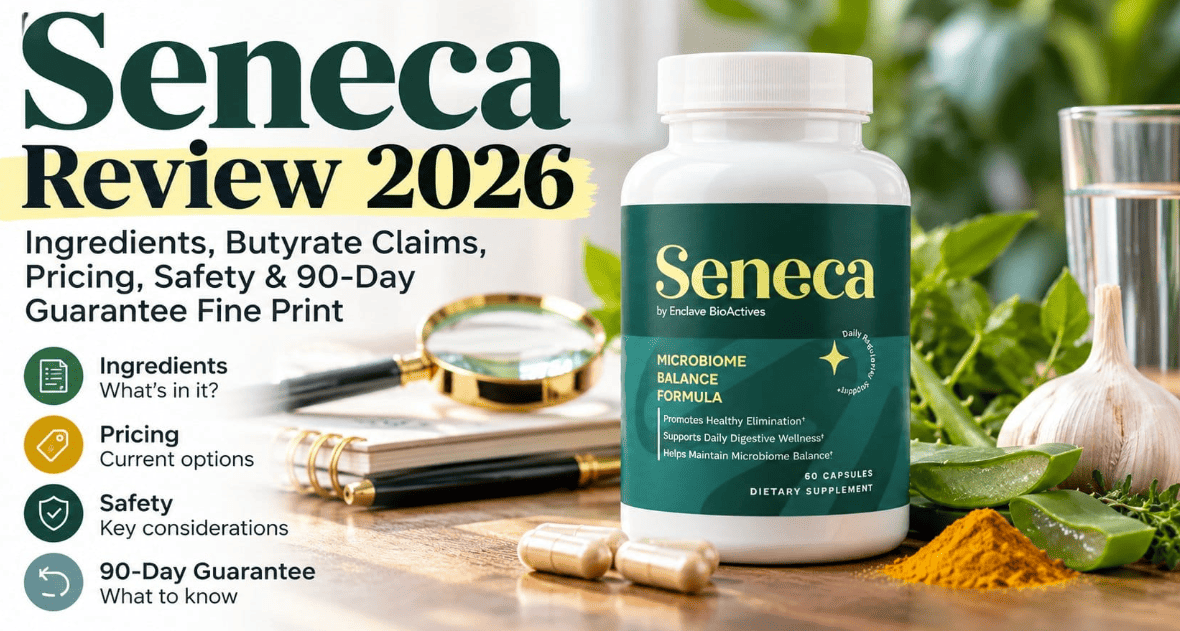
Seneca is a dietary supplement from Enclave Bioactives that pairs a named-strain probiotic blend with sodium butyrate, berberine, and several supporting ingredients. The brand markets it as a microbiome restoration formula for adults who notice bloating after meals, irregular bowel habits, or that fiber and generic probiotics never quite did the job. This review works through the label, the pricing, the refund policy, and the open questions so you can decide with the facts in view.
One heads-up before we go further. This is consumer research, not medical advice. Seneca is a dietary supplement, not a drug, and it is not FDA-approved. Nothing below replaces a conversation with a qualified healthcare professional, especially if your symptoms are new, severe, or worsening.
What Is Seneca and What Is Actually Inside
The label is the first thing worth reading, and it is also the one place where you can verify claims yourself. The Supplement Facts panel on the brand's product page lists every ingredient by amount, and it is the controlling source when a headline or an ingredient card disagrees.
The Supplement Facts Panel, Ingredient by Ingredient
A serving is two capsules, with 30 servings per container. Per the live panel reviewed in October 2026, one serving provides:
- Vitamin D3 (as cholecalciferol). 50 mcg, listed at 250 percent of the Daily Value.
- Sodium butyrate. 350 mg per serving.
- Aged garlic extract (bulb, standardized to 1.2 percent S-allyl-cysteine). 250 mcg.
- Berberine hydrochloride (from Phellodendron amurense bark). 150 mg.
- Probiotic blend. 20.5 billion CFU, with a listed blend weight of 102.5 mg.
- L-glutamine. 75 mg.
- Aloe vera gel extract (leaf). 50 mg.
Other ingredients are hypromellose, brown rice flour, microcrystalline cellulose, stearic acid, and calcium silicate. The panel reviewed did not include an allergen statement, so check the physical bottle if you have known sensitivities to garlic, aloe, or yeast.
The Seven Probiotic Strains
The probiotic blend names seven strains, each listed with its percentage of the blend. That level of strain transparency is more than many competitors provide.
- Bifidobacterium lactis HN019. 55 percent.
- Lactiplantibacillus plantarum CCFM8610. 10 percent.
- Lactiplantibacillus plantarum CCFM8724. 10 percent.
- Lactobacillus rhamnosus GG. 10 percent.
- Lactobacillus plantarum LP299v. 5 percent.
- Bacillus coagulans CCFM1041. 5 percent.
- Saccharomyces boulardii HS5. 5 percent.
One detail deserves attention. The panel says the 20.5 billion CFU count is at time of manufacture. That is the count when the product was made, not a guarantee about the count when you open the bottle. Storage conditions matter with live cultures.
"The panel is the only place that shows actual amounts, and it is the one source that controls when a headline, an ingredient card, and a label disagree."
Consumer research note
What the Ad Says vs What the Label Shows
Here is the section a quick skim of the ad will not show you. The offer page behind the video and the brand's product page do not describe Seneca the same way, and neither matches the panel word for word. None of this is an accusation. The rule is simple: when sources disagree, the label controls.
Headline vs Panel on Probiotics
The offer page headline promises results without fiber, laxatives, or probiotics. The panel lists a seven-strain probiotic blend at 20.5 billion CFU. The formula is more than a probiotic, but probiotics are a core part of the capsule. If you have decided you are done with probiotics, this is not a probiotic-free product.
Microencapsulation and Spotlighted Ingredients
The ingredient card calls the butyrate microencapsulated. The panel lists sodium butyrate without that word. The claim may be accurate, but on the panel as fetched it is a marketing description rather than a labeled specification. Vitamin D3 and aged garlic extract are on the panel but not among the four featured ingredient cards. If you already take vitamin D, add up your total.
How Much Does Seneca Cost?
Pricing was checked on the live offer page in October 2026. The same package prices appear on the brand's product page.
| Package | Supply | Total | Per Bottle | Per Day |
|---|---|---|---|---|
| Starter | 30 days | $59 | $59 | $1.97 |
| Doctor's Choice | 90 days | $147 | $49 | $1.63 |
| Gut SuperHero | 180 days | $234 | $39 | $1.30 |
Per-day figures use displayed prices and exclude shipping and tax. The one-bottle option shows a $4.95 shipping fee on the offer page. The brand also displays reference prices of $99, $297, and $594, which are brand-stated comparison figures, not independent benchmarks.
Is There a Subscription?
No subscription toggle appears on the offer pages reviewed. The brand's Terms and Conditions, however, describe subscription pricing in general, with automatic renewals at 28, 30, 56, or 364-day intervals. Check the final checkout screen for recurring-billing language before you pay, and keep your confirmation email.
The 90-Day Guarantee and What the Fine Print Reveals
The offer page advertises a 90-day no questions asked money-back guarantee. The brand's Shipping and Refund Policy adds the details. Read both before choosing a package size, because the single bottle and the multipacks carry different refund considerations.
Single Bottle vs Multipack Refunds
- Single bottle. The used bottle does not need to be returned, and a full refund follows the brand's refund form. One refund like this is allowed per product per year.
- Multipacks. Unused, unopened bottles are returned. If one bottle was used, the policy refunds it plus the returned bottles. If more than one was used, it refunds the first bottle plus the unopened returns, but not the second or later bottles used.
- Deductions. Shipping and handling fees are deducted, and the policy also mentions excluding 10 percent for shipping and handling where applicable.
- Deadline. After 90 days from purchase, the policy says no refund or exchange is available.
How to Request a Refund
The refund process runs in a few clear steps, according to the brand's policy.
- Send the request. Use the brand's support channel within the 90-day window.
- Return multipack bottles. In the USA, a prepaid label is emailed for unused, unopened bottles.
- Expect deductions. Shipping and handling fees come off the refund.
- Allow time. About a week for the return to ship, another week for processing, then five to seven business days for the bank.
- Keep records. Dated screenshots and the order confirmation make the request easy to support.
Safety, Side Effects, and Who Should Avoid It
The finished product's side-effect profile is not documented in a published trial on the pages reviewed. Individual ingredients matter though, and one in particular deserves a careful read.
Berberine and Medication Interactions
Seneca contains 150 mg of berberine hydrochloride per serving. The National Center for Complementary and Integrative Health reports that berberine's side effects in research were mainly digestive, including nausea, abdominal pain, bloating, constipation, and diarrhea. That is worth noting because those are often the symptoms people hope to improve. NCCIH also says berberine may interact with medicines, with cyclosporine as one cited example.
Pregnancy, Breastfeeding, and Other Cautions
- Pregnancy and breastfeeding. NCCIH advises that people who are pregnant or breastfeeding should not use berberine, citing a link to a harmful buildup of bilirubin in infants.
- Weakened immune system. A 2026 review of probiotic safety in Nutrients concludes that probiotics are generally safe for healthy people but call for caution in anyone with a weakened immune system.
- Vitamin D3. At 50 mcg per serving, add this to anything else you take, especially if you already supplement.
- Allergens. The formula contains garlic extract, aloe extract, and a yeast probiotic. Check the physical bottle for allergen text, since the panel reviewed did not include an allergen statement.
Is There Clinical Research on Seneca Itself?
No finished-product clinical study is cited on the brand pages reviewed. None. That does not mean Seneca cannot work for some people. It means there is no published, product-specific evidence to point to, so the claims rest on mechanism, ingredient research, and testimonials.
What "Clinically Studied" Actually Means
The brand's FAQ describes berberine and aloe inner leaf as clinically studied nutrients and says every ingredient in Seneca is clinically studied. Those statements concern individual ingredients, not the Seneca formula at these doses. Clinically studied ingredients and a clinically studied product are different statements. Only the first appears on the brand's pages.
Butyrate: Real Biology, Missing Product Data
Butyrate is a short-chain fatty acid that certain gut bacteria produce when they ferment fiber, and colon cells use it as fuel. That part is well established. What is not established is whether 350 mg of sodium butyrate plus a probiotic blend does what the ad implies for your digestion. Published butyrate research often involves specific forms and doses, and results do not automatically carry over to another product. A randomized placebo-controlled study of a tributyrin-based supplement, a different butyrate form, reported undetectable blood butyrate, which the authors attributed to its transient nature or a low dose. That study is not about Seneca, and it does not say butyrate supplements are useless. It shows why product-specific evidence matters.
"Butyrate matters in the gut is not the same as this capsule will change your digestion."
Ingredient research versus product evidence
Dr. Gina Sam, MD: What Is Verifiable
The offer page features a physician presenter, Gina Sam, MD. Unlike a presenter nobody can find, this one is checkable. Public provider records and independent directories list her as a gastroenterologist with a medical degree from Tufts University School of Medicine, internal medicine training at Lenox Hill Hospital, a gastroenterology fellowship at NYU, and American Board of Internal Medicine certification in gastroenterology. One directory lists an active New York State medical license.
Credentials vs Claims
Three points need precision. The offer page says she served as director of the Mount Sinai GI Motility Center, which fits a past role and does not say she is currently there. A Top Gastroenterologist 2024 badge appears on the page without naming its issuer, and a 2024 designation was not located on her practice site's list of honors. The FAQ answers are written in the first person by a physician, but the page text does not attribute each answer to a named person. The relationship between Dr. Sam and the brand is not described on the pages reviewed. A credentialed presenter still does not turn marketing claims into clinical findings.
Seneca vs Ordinary Probiotics
The brand's FAQ says most probiotics never reach the part of the gut that needs them because stomach acid wipes out the majority. That is a sweeping statement. The National Institutes of Health position is more nuanced: a probiotic's benefits, if any, depend on the specific strains and the CFU count, and a higher count alone does not guarantee more benefit.
What the Formula Adds
Seneca adds a direct butyrate source, berberine, L-glutamine, aloe, vitamin D3, and garlic extract alongside the probiotic strains. The real comparison is not probiotic versus something magical. It is a single-category probiotic versus a multi-ingredient formula. More ingredients means more to evaluate, with more potential benefit in the brand's view and more potential interactions in a cautious one.
Who Should Look Elsewhere
- Pregnancy, breastfeeding, or trying to conceive. Berberine carries NCCIH cautions for those groups.
- Anyone on prescription medicines. Especially without having checked with a pharmacist or physician.
- People with a weakened immune system. Probiotic safety reviews call for caution in that group.
- New, severe, or worsening symptoms. Or any blood in stool or unexplained weight loss, which call for medical evaluation.
- Anyone looking for a weight-loss product. The brand itself says that is not the purpose.
Who Makes Seneca and Where Can You Buy It
The panel lists Seneca as manufactured for Enclave Bioactives. The brand's Terms and Conditions name Konscious LLC, Enclave LLC, and Vital Health LLC, with affiliated entities, doing business as Enclave Bioactives among other brands. The facility that actually produces the capsules is not named on the pages reviewed, though the brand says it is an FDA-registered, GMP-certified US facility. FDA registration of a facility is not FDA approval of the facility or the product.
Amazon and Unauthorized Sellers
The brand states that the only place to get authentic Seneca is its official website, and that listings on Amazon, eBay, or other sites are not authorized. Search results do show Amazon listings for similarly named Seneca products, and this review has not verified who sells them or what is inside. Buy through the official offer page, where the guarantee and refund policy apply, and skip listings that cannot be traced to the brand.
What Buyers Say and What Independent Records Show
The offer page shows six testimonials with first names and cities, a five-star display, and a customer badge. The product page shows four of the same stories next to a 5.0 out of 5.0 rating. The platform and number of ratings behind that score are not disclosed.
Brand-Published Testimonials
The testimonials are brand-published, have not been independently audited, and show what the brand chose to feature. They are not a picture of what the average buyer experiences. Individual results vary. Look for independent reviews on retailer or review platforms before leaning on the stories.
BBB and Trustpilot
The Better Business Bureau profile for Enclave, LLC states the business is not BBB accredited, shows a B rating, and cites complaints among the reasons for that rating. Trustpilot pages for the company's sites, as surfaced in search results, show a small number of reviews, several negative, describing trouble reaching customer service, refund and cancellation disputes, billing problems, and shipping delays. These are unverified consumer statements, and a handful of reviews does not describe every customer's experience. They work best as prompts: confirm the final total at checkout, keep every confirmation, and use written channels.
Seven Things to Verify Before You Order
These are the open items this review could not confirm from the pages reviewed, each with a simple next step.
- The featured physician's relationship with the brand. Ask whether Dr. Sam is compensated, an owner, or an advisor.
- The Top Gastroenterologist 2024 badge. No issuing organization is named on the page.
- Strain-level data. Ask for documentation showing the strains in the blend produce butyrate and what amounts survive to expiry.
- Facility and certificates. Ask for the facility name and any third-party lab reports.
- Shipping fee wording. The single bottle shows a fee on the offer page while the shipping policy describes free mainland delivery. Check the final checkout total.
- As seen on logos and the 5.0 rating. Neither was confirmed on the pages reviewed.
- Support access and billing. Confirm the total at checkout, remember that orders cannot be modified once placed, and save every confirmation.
Frequently Asked Questions
What is Seneca?
Seneca is a dietary supplement from Enclave Bioactives that combines a seven-strain probiotic blend, sodium butyrate, berberine, L-glutamine, aloe vera gel extract, vitamin D3, and aged garlic extract in a two-capsule serving. It is sold direct through the brand's offer page in one-, three-, and six-bottle packages with a conditional 90-day guarantee.
Is Seneca FDA-approved?
No. Seneca is a dietary supplement, and the brand's own disclaimer says its statements have not been evaluated by the FDA and that it is not intended to diagnose, treat, cure, or prevent any disease. Dietary supplements are not FDA-approved before they are sold, and a facility's FDA registration is not approval of the facility or the product.
How do you take Seneca?
The panel lists a serving size of two capsules and 30 servings per container, which works out to 60 capsules per bottle. The offer page labels one bottle a 30-day supply, consistent with one serving per day. Exact directions belong on the physical bottle label, so confirm timing and whether to take it with food on the bottle you receive.
Does Seneca have side effects?
The finished product's side-effect profile is not documented in a published trial on the pages reviewed. Individual ingredients matter. NCCIH reports that berberine's side effects in research were mainly digestive, that it can interact with medicines, and that people who are pregnant or breastfeeding should not use it. Anyone on prescription medicines or who is pregnant should talk with a clinician or pharmacist before trying Seneca.
Is Seneca safe during pregnancy or breastfeeding?
NCCIH advises that people who are pregnant or breastfeeding should not use berberine, which Seneca contains at 150 mg per serving. Speak with an obstetrician or other healthcare professional before considering it.
Can Seneca help with constipation or diarrhea?
The brand's FAQ says it can, describing both as connected to an imbalanced microbiome. Independent sources paint a broader picture. NIDDK lists many causes of constipation, including slow stool movement, functional disorders, medicines, low fiber, and hormone-related conditions. Persistent bowel changes, blood in stool, or constant abdominal pain call for a medical evaluation rather than a supplement trial.
Where can you buy Seneca?
The brand says the only authorized place to buy authentic Seneca is its official website. Listings on Amazon, eBay, or other marketplaces are described as not authorized. Buy through the official offer page so the guarantee and refund policy apply, and skip listings that cannot be traced to the brand.
Is there a Seneca subscription?
No subscription option was confirmed on the offer pages reviewed, where the packages appear as one-time purchases. The brand's Terms and Conditions describe subscription pricing in general, so check the final checkout screen for recurring-billing language and keep the confirmation email.
The Bottom Line
Seneca is a multi-ingredient gut supplement that pairs a named-strain probiotic blend with sodium butyrate, berberine, L-glutamine, aloe, vitamin D3, and garlic extract. The label is transparent about amounts, public records identify the featured physician as a gastroenterologist, and the pricing is clear. The benefits, timelines, testimonials, and manufacturing claims are brand-reported. No finished-product trial is cited, the physician's relationship with the brand is not described, and the facility details are not named. Some FAQ statements outrun the independent sources.
The 90-day guarantee provides a defined refund window, subject to the conditions in the current refund policy. The single bottle and the multipacks carry different refund considerations for used and unopened bottles, so package size is worth deciding with the policy open. If you remain interested after reviewing the ingredient profile, the medication considerations, and the refund terms, a conversation with a qualified healthcare professional is the right next step.